I come up with ideas for inventions all the time. However, there are only so many hours in a day, and I simply can't work on all of my inventions. Sometimes I'll start on something, get sidetracked by five or six other projects, and then ten, fifteen years down the road someone else has turned it into a commercial product. Good for them.
I came up with an idea for a product over the holidays, and I just don't have the time to work on it (I have four other projects on the go). This is an idea that will make someone a millionaire, and I don't have the time, so I'm just giving it away.
I live in Canada, and if you live here or in Russia or any other country that experiences really hard winters you have seen this problem: as people drive, their tires fling snow up into the wheel wells. The tires are warmer than the snow, and the snow melts a little before hitting the wheel wells and re-freezing. Ice then builds up in the wheel wells, particularly behind each wheel. It will build up there until the ice is touching the wheel, at which point the wheel polishes the ice. Eventually a car will be carrying hundreds of pounds of ice in the wheel wells. This can be really dangerous, particularly if it breaks off under its own weight while you're driving down the highway, or if it begins to interfere with the steering.
For most people in winter nations, this minor annoyance is dealt with by kicking each wheel well as one is going around the car scraping ice off the windows, and periodically kicking at the ice buildup. Or, not bothering and just carrying around hundreds of pounds of ice (full of road salt, which does lovely things to a paint job) and taking the hit to gas mileage.
But there is a better way. Cars sold in winter nations come equipped with rear window defrost, an electrical circuit that includes wires embedded inside the rear window. These wires heat up when current passes through them, much like the Ni-Chrome wires in a toaster. A similar system is in place in ICBMs and spacecraft to keep electronics at a good operating temperature. Specifically, Pershing missiles contained a type of fabric that had Ni-Chrome wires embedded in the weave, and the fabric was wrapped around various components. Then a little current went through the wires and the rest of the fabric acted as a buffer to spread the heat evenly.
This same kind of fabric, or a modern equivalent, can be placed on the top/back of each wheel well in a car, inside the engine compartment and inside the trunk. The wiring for each of these heaters can be tied in parallel to the wiring for the rear window defrost circuit. Then when the driver turns on the rear window defrost, the missile heaters on the wheel wells will melt the ice clinging to the surface, causing any accumulated ice to fall off the wheel well, and preventing buildup long before it becomes dangerous.
As I said, I don't have the time to work on this. If someone else wants to do it and sell it to car companies and aftermarket suppliers, go hard.
Monday, January 05, 2015
Tuesday, December 09, 2014
Monday, November 03, 2014
Bad Days
This has been a bad week for the nascent commercial space launch industry. First, the Orbital Sciences Antares rocket had to be destroyed shortly after takeoff. Then the Virgin Galactic Space Ship 2's feather mechanism prematurely deployed during a test flight, causing the craft to lose control and break apart, killing Michael Alsbury and injuring Pete Siebold.
In each case, it was a Bad Day.
NASA has had Bad Days. The Soviet space program had Bad Days. The Chinese space program has had Bad Days.
There will be more Bad Days. Lots more.
There were Bad Days for the crew of Magellan, and Cook, and Franklin, and others. There were Bad Days in the exploration of every continent, and in the climbing of Earth's highest peaks.
So why do we humans do this? Why do we risk our lives on these things? Why do guys like Michael Alsbury and Peter Siebold put their lives right out there at the razor's edge of what's possible with the best of current technology, just for a test?
We do it for the same reason that John Stapp strapped himself into a rocket sled, for the same reason hundreds of barnstormers died flying their designs, for the same reason that countless pilots have died just a few miles from the SpaceShipTwo crash site.
We human beings need to expand our civilization. We do it by exploring, by going further and faster and higher and deeper, pushing the edge of the envelope, by blazing a trail so that others may follow. Those that do follow build on the foundation left by those who came before, and make it easier for others to follow.
We stand on the shoulders of giants, yes, but we also stand on their sweat and their tears, and their blood.
In each case, it was a Bad Day.
NASA has had Bad Days. The Soviet space program had Bad Days. The Chinese space program has had Bad Days.
There will be more Bad Days. Lots more.
There were Bad Days for the crew of Magellan, and Cook, and Franklin, and others. There were Bad Days in the exploration of every continent, and in the climbing of Earth's highest peaks.
So why do we humans do this? Why do we risk our lives on these things? Why do guys like Michael Alsbury and Peter Siebold put their lives right out there at the razor's edge of what's possible with the best of current technology, just for a test?
We do it for the same reason that John Stapp strapped himself into a rocket sled, for the same reason hundreds of barnstormers died flying their designs, for the same reason that countless pilots have died just a few miles from the SpaceShipTwo crash site.
We human beings need to expand our civilization. We do it by exploring, by going further and faster and higher and deeper, pushing the edge of the envelope, by blazing a trail so that others may follow. Those that do follow build on the foundation left by those who came before, and make it easier for others to follow.
We stand on the shoulders of giants, yes, but we also stand on their sweat and their tears, and their blood.
Wednesday, October 22, 2014
Asimov on Brainstorming
While cleaning out old files, Arthur Obermayer found an unpublished essay written by his good friend Isaac Asimov; it has now been published (with permission from Asimov Holdings) at MIT Technology Review. The essay starts out by trying to figure out what it takes to come up with the big creative ideas, then transitions to how to get small groups of people to brainstorm in order to spark those ideas.
Tuesday, September 30, 2014

Tuesday, July 01, 2014

Tuesday, April 22, 2014
Space Based Solar Power
Via Instapundit and Transterrestrial Musings, this Wired article by David S. F. Portree serves as a good introduction to space based solar power. However, the article only skims the surface. It doesn't mention Gerard K. O'Neill, who envisioned space based solar power as the impetus for space colonization in The High Frontier; the book is directly responsible for the creation of the L-5 society and the Space Studies Institute.

The article also stops around 1980 or so. However, many people have continued to work on the many facets of the issues surrounding solar power satellites (hereafter referred to as SPS), and far more recently. One notable example is the work of Colonel M.V. “Coyote” Smith, particularly in 2007 and 2008 for the National Security Space Office.
I have done some work on inexpensive solar power. I was heavily involved in the build in the video below (I'm the bald guy, with more hair and about 60 pounds heavier than today).
What we built was very inexpensive. With a couple of blind alleys and two failed designs before the one in the video, and including salaries, CNC machining of the prototype turbine (shown powering up some light bulbs using compressed air in the video), raw materials and other expenses, the whole project only cost $100 grand over a period of eight months. And it convinced me that for industrial scale solar power, a heat engine is the only way to go.
Right now, all of the electrical power supplied by coal or natural gas or nuclear power is converted into electricity through the use of a heat engine. The coal or gas or uranium is burned (or fissions) to heat a boiler which turns water into steam. The steam drives a turbine, converting the heat energy into kinetic energy. The turbine drives a generator, turning kinetic energy into electricity. (Hydroelectric power does the same process, substituting gravitational potential energy for heat energy, but the turbine/generator idea remains the same.)
In other words, we have lots of experience with using heat engines to produce electrical power on an industrial scale. The design problems and constraints and tradeoffs are well-characterized and understood through over a hundred years of operational experience worldwide.
Heat engines are dominated by a single equation: Carnot's Theorem. The maximum efficiency of a heat engine is
μ = 1 - T(cold)/T(hot)
where T is a temperature in Kelvin of the cold side and the hot side of the engine. All heat engines are constrained by this equation.
There are a few advantages to putting large scale solar power structures into space: nearly continuous sunlight, the ability to make arbitrarily-large flimsy structures, lack of atmosphere. However, the greatest advantage may lie in the Carnot theorem. The background temperature in deep space (in the shade) is around 3 Kelvin. That means that the hot side only needs to be greater than 300 Kelvin (27 degrees Celsius or 81 Fahrenheit) for the maximum efficiency to exceed 99 percent. To be sure, there are losses associated with conversion from heat to motion and from motion to electricity and from electricity to microwave and back, but such losses are mirrored in conventional systems.
On Earth, there is a broad range for the daylight background temperature depending on location and time of year. However, under the best of circumstances a power plant's background temperature will be as low as possible. A background temperature of 40 degrees below zero (C or F) is about as cold as it gets for heavily populated areas of the world. At that temperature, roughly 233 Kelvin, we can see that for a maximum efficiency of 0.99 the hot side of the boiler needs to be about 23 thousand degrees Celcius!
Clearly our current heat engines, for which most of the world relies for electrical power, have nowhere near 99% maximum efficiency. Conversely, a heat engine with a 600 degree Celsius hot side, which would have a maximum efficiency of 99.5% in space, would only have a maximum efficiency of about 73%with a 40 below cold sink. (If I've made a mistake on the math it's because I'm converting between Kelvin and Celsius and Fahrenheit; please correct me in the comments.)
If one is building an SPS out of photovoltaics, then every part of a vast satellite is an expensive electronic instrument. However, if one uses a heat engine, then the collection area needs to be little more than aluminum foil stretched across a frame. The aluminum sheets are positioned and angled so that they reflect the sunlight as a giant parabolic mirror focused on the boiler. Sort of like this, at a hundred times the size:

Then the vast majority of the mass and structure of the SPS is nothing more complex or expensive than aluminum foil. It can be made arbitrarily large, right up to the thermal limits of the boiler.
Although only large-scale grid-connected rectennas are illustrated in the Wired article, supplying a city with grid power isn't the only possible application. There is a geometric relationship between transmitter and receiver size. The larger the broadcast antenna, the smaller the receiver needs to be. With a large enough broadcast antenna, a receiver could be small enough to fit inside a car, powering an electric vehicle from space. This would be particularly useful on the battlefield, drastically changing the logistics of keeping tanks in the field.
The power generated at an SPS doesn't need to be directed down to earth as microwaves. It could be beamed as a laser to a receiver on a space vehicle. With an SPS as an external power source, a space vehicle can use almost anything as a propellant in a plasma thruster. Just heat up the propellant with microwaves using power beamed by laser from the SPS, and suddenly the specific impulse of the propellant is an order of magnitude higher than if one was to simply burn Hydrogen and Oxygen. Beamed power would revolutionize inter-orbital transport.
Yet another advantage accrues to using a large Aluminum reflector to gather light. Since Aluminum is a commodity, it doesn't matter where the material comes from. Aluminum from Canada is the same as Aluminum from anywhere else in the world. And it's the same as the Aluminum found in the rocks on the surface of the moon. Although the first few SPSats in orbit would need to be entirely shipped up from Earth, those satellites could power mining operations on the moon and the plasma thrusters needed to bring the Aluminum to orbit, to be fashioned into subsequent solar power satellites. The existence of SPS would thus be both a driver and an enabler for in-situ resource utilization of the Moon - and subsequently, everywhere else in the solar system.

The article also stops around 1980 or so. However, many people have continued to work on the many facets of the issues surrounding solar power satellites (hereafter referred to as SPS), and far more recently. One notable example is the work of Colonel M.V. “Coyote” Smith, particularly in 2007 and 2008 for the National Security Space Office.
I have done some work on inexpensive solar power. I was heavily involved in the build in the video below (I'm the bald guy, with more hair and about 60 pounds heavier than today).
What we built was very inexpensive. With a couple of blind alleys and two failed designs before the one in the video, and including salaries, CNC machining of the prototype turbine (shown powering up some light bulbs using compressed air in the video), raw materials and other expenses, the whole project only cost $100 grand over a period of eight months. And it convinced me that for industrial scale solar power, a heat engine is the only way to go.
Right now, all of the electrical power supplied by coal or natural gas or nuclear power is converted into electricity through the use of a heat engine. The coal or gas or uranium is burned (or fissions) to heat a boiler which turns water into steam. The steam drives a turbine, converting the heat energy into kinetic energy. The turbine drives a generator, turning kinetic energy into electricity. (Hydroelectric power does the same process, substituting gravitational potential energy for heat energy, but the turbine/generator idea remains the same.)
In other words, we have lots of experience with using heat engines to produce electrical power on an industrial scale. The design problems and constraints and tradeoffs are well-characterized and understood through over a hundred years of operational experience worldwide.
Heat engines are dominated by a single equation: Carnot's Theorem. The maximum efficiency of a heat engine is
where T is a temperature in Kelvin of the cold side and the hot side of the engine. All heat engines are constrained by this equation.
There are a few advantages to putting large scale solar power structures into space: nearly continuous sunlight, the ability to make arbitrarily-large flimsy structures, lack of atmosphere. However, the greatest advantage may lie in the Carnot theorem. The background temperature in deep space (in the shade) is around 3 Kelvin. That means that the hot side only needs to be greater than 300 Kelvin (27 degrees Celsius or 81 Fahrenheit) for the maximum efficiency to exceed 99 percent. To be sure, there are losses associated with conversion from heat to motion and from motion to electricity and from electricity to microwave and back, but such losses are mirrored in conventional systems.
On Earth, there is a broad range for the daylight background temperature depending on location and time of year. However, under the best of circumstances a power plant's background temperature will be as low as possible. A background temperature of 40 degrees below zero (C or F) is about as cold as it gets for heavily populated areas of the world. At that temperature, roughly 233 Kelvin, we can see that for a maximum efficiency of 0.99 the hot side of the boiler needs to be about 23 thousand degrees Celcius!
Clearly our current heat engines, for which most of the world relies for electrical power, have nowhere near 99% maximum efficiency. Conversely, a heat engine with a 600 degree Celsius hot side, which would have a maximum efficiency of 99.5% in space, would only have a maximum efficiency of about 73%with a 40 below cold sink. (If I've made a mistake on the math it's because I'm converting between Kelvin and Celsius and Fahrenheit; please correct me in the comments.)
If one is building an SPS out of photovoltaics, then every part of a vast satellite is an expensive electronic instrument. However, if one uses a heat engine, then the collection area needs to be little more than aluminum foil stretched across a frame. The aluminum sheets are positioned and angled so that they reflect the sunlight as a giant parabolic mirror focused on the boiler. Sort of like this, at a hundred times the size:
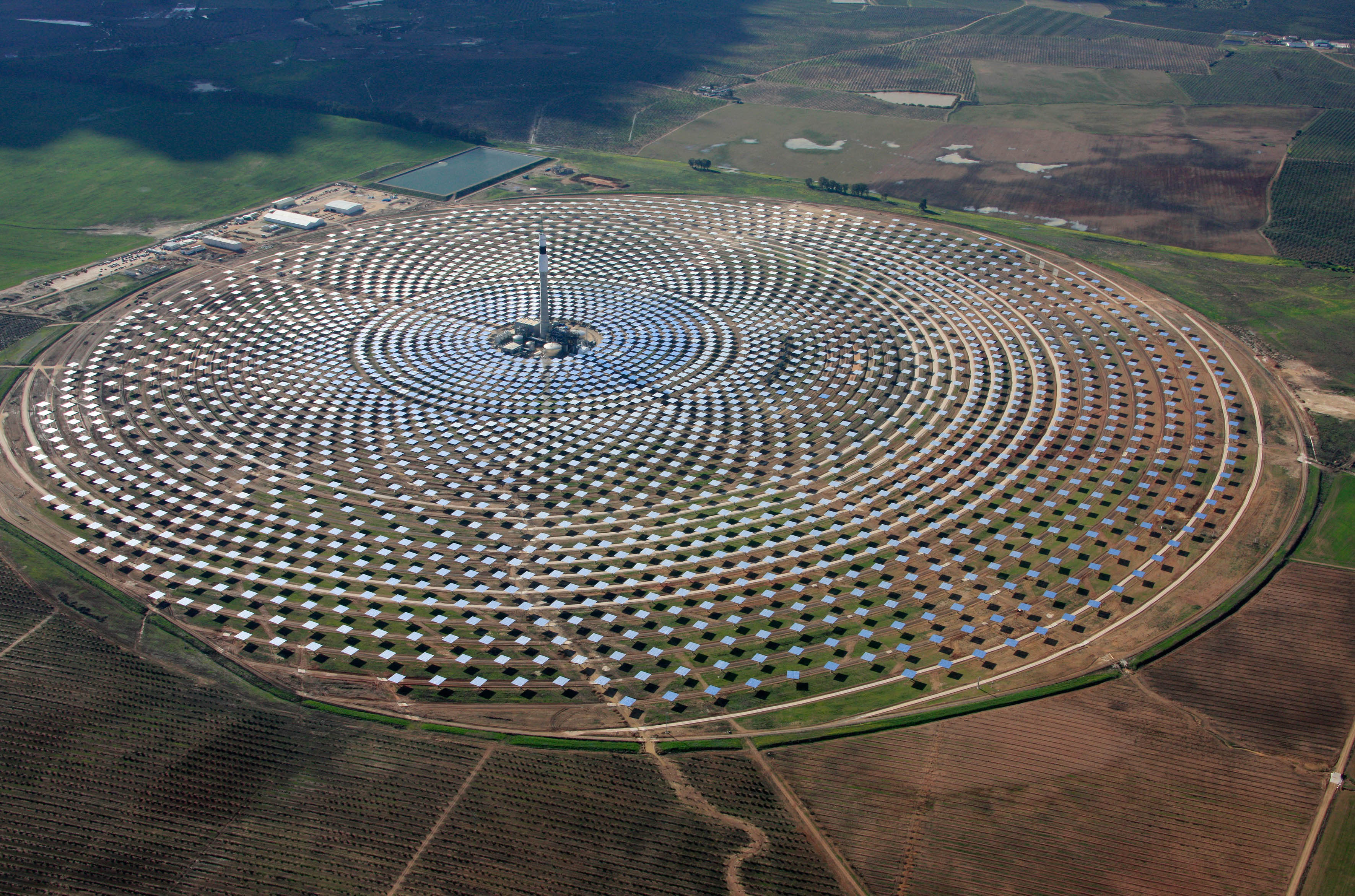
Then the vast majority of the mass and structure of the SPS is nothing more complex or expensive than aluminum foil. It can be made arbitrarily large, right up to the thermal limits of the boiler.
Although only large-scale grid-connected rectennas are illustrated in the Wired article, supplying a city with grid power isn't the only possible application. There is a geometric relationship between transmitter and receiver size. The larger the broadcast antenna, the smaller the receiver needs to be. With a large enough broadcast antenna, a receiver could be small enough to fit inside a car, powering an electric vehicle from space. This would be particularly useful on the battlefield, drastically changing the logistics of keeping tanks in the field.
The power generated at an SPS doesn't need to be directed down to earth as microwaves. It could be beamed as a laser to a receiver on a space vehicle. With an SPS as an external power source, a space vehicle can use almost anything as a propellant in a plasma thruster. Just heat up the propellant with microwaves using power beamed by laser from the SPS, and suddenly the specific impulse of the propellant is an order of magnitude higher than if one was to simply burn Hydrogen and Oxygen. Beamed power would revolutionize inter-orbital transport.
Yet another advantage accrues to using a large Aluminum reflector to gather light. Since Aluminum is a commodity, it doesn't matter where the material comes from. Aluminum from Canada is the same as Aluminum from anywhere else in the world. And it's the same as the Aluminum found in the rocks on the surface of the moon. Although the first few SPSats in orbit would need to be entirely shipped up from Earth, those satellites could power mining operations on the moon and the plasma thrusters needed to bring the Aluminum to orbit, to be fashioned into subsequent solar power satellites. The existence of SPS would thus be both a driver and an enabler for in-situ resource utilization of the Moon - and subsequently, everywhere else in the solar system.
Subscribe to:
Posts (Atom)